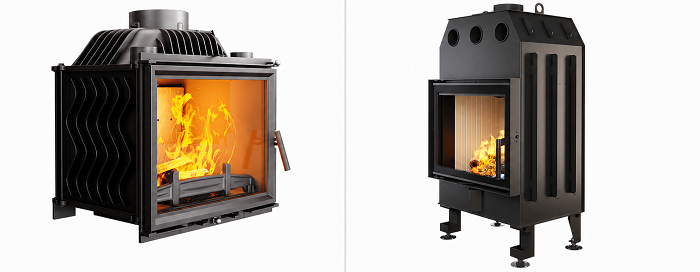
Ukrainian manufacturer of steel stoves, fireplace inserts and ventilation grilles
KAWMET is a Polish manufacturer of cast iron fireplace inserts and freestanding stoves. The family foundry has been running since 1981: founded by Stanisław Kawiński, it is now led by his son Marek. In 2026 the works turn 45 — and it has stayed in the same hands the whole time.
The plant sits in Zadąbrowie near Orły in south-eastern Poland, on the international E-4 route Dresden — Kraków — Lviv. Everything you buy here is made inside the European Union, tested to European standards and shipped from the EU — with no customs surprises for European buyers and a short haul east.
What matters most about the quality: KAWMET runs its own full-cycle foundry — the iron is melted on site, not bought in as ready castings. SAVEN is the official KAWMET distributor: 87 items in stock — 38 fireplace inserts and 49 stoves, a 5-year factory warranty and service beyond it. We also officially represent the Danish brand MORSO — not a competitor, but a different character of cast iron.
A real foundry, not an assembly line. The iron is melted on site — 2000 kg induction furnaces, a DISA moulding line, an Eirich mixer. Every batch is checked by spectral analysis of the chemical composition and tested for strength and hardness.
45 years in one family. Founded in 1981 and now run by the second generation. That means predictable quality — and a manufacturer that will not disappear along with your warranty.
5-year warranty, plus service after it. 60 factory months on the body. As the official distributor we keep servicing the appliance afterwards, with access to factory spare parts.
Secondary combustion and ECO class. The whole current range is Ecodesign-compliant. Secondary burn consumes the gases that an ordinary stove sends straight up the flue: less wood for the same heat, and less soot.
Made in the European Union. Manufactured in Poland to European standards, with EU test reports behind it — no import surprises, and spare parts that actually ship.
KAWMET — official manufacturer documents
Click on the photo of the certificate to view it in full
ISO 9001:2015 and ISO 14001:2015 certificate — KAWMETThe KAW-MET foundry operates an integrated quality and environmental management system. Certificate No. 1996/09/2024/ZSZ/C issued by Polska Akademia Jakości Cert (PCA accreditation AC 137), valid until 26.09.2027. Scope: design and manufacture of fireplace inserts and iron castings.
An insert is a cast iron firebox built into a surround — you decide how the finished fireplace looks. A stove is a complete appliance: you stand it on the floor, connect the flue, and no masonry is needed. KAWMET offers 38 inserts in the W series and 49 stoves across the P, Premium, HARITA and VENUS lines.
5 years (60 months) factory warranty on the body — the standard across the current range. Once it expires we continue to service the appliance as the official distributor, with access to factory spare parts.
The working rule of thumb is 1 kW per 10 m² at normal ceiling height and normal insulation, so roughly 10 kW for a 100 m² house. Ceiling height, glazed area and any other heating all shift the figure, so it is worth checking with us. The KAWMET range covers roughly 6.8 to 25 kW.
Cast iron is thicker and heavier, so it keeps radiating heat long after the fire has died down, and it burns away far more slowly near the flame. A steel firebox heats up faster but also cools faster, and thin steel warps over the years. For daily heating cast iron lasts longer; for the occasional weekend fire the difference matters less.
That the appliance meets the European Ecodesign regulation and has secondary combustion. Gases that an ordinary stove sends straight up the chimney are burned here instead — more heat from the same load of wood and less soot in the flue. The entire current KAWMET range is ECO.
From 24 757 UAH for the P9 stove up to 90 265 UAH for the W16 PB Black insert. The most affordable way in is the P series and the W9 and W13A inserts. Prices on the site are current and availability is shown on each product page.
Yes. We work with buyers across Europe and handle export paperwork ourselves; the factory itself is inside the EU, which keeps delivery straightforward. Write to us with your country and the model you are considering and we will confirm cost and lead time.
Cast iron fireplace insert of convection type Kawmet: how to choose and where to buy a cast iron insert
Cast iron fireplace insert is the heart of a fireplace. Its proper choice determines how quickly it will warm your home and how long it will retain heat. Buying a cast iron fireplace is a wise investment in the comfort and warmth of your home.
But before choosing a fireplace insert, you should understand which one is right for you. To do this, you need to know the types of cast iron inserts, their characteristics, how they work, and how they differ from other fireplace inserts.
So if you’ve decided to buy a fireplace insert, this article will help you make the right choice and understand all the nuances of the "fireplace matter."
Buying a fireplace insert: mission accomplished
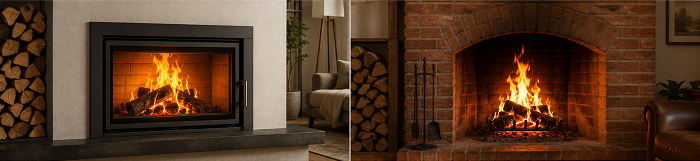
Let's start with the fact that fireplace inserts come in various types, from electric and bio-fireplaces to classic wood-burning inserts. Electric and bio-fireplaces are mostly chosen by apartment owners since they don't require a chimney connection. If you want a real flame and the pleasure of a burning fireplace, it's better to choose the classic option and buy a wood-burning insert.
A fireplace insert is the main element of a fireplace where fuel combustion actually occurs. Therefore, many factors depend on its choice: heating area, fuel type, operating mode, appearance, etc.
So, when choosing a fireplace insert, there are several rules that we will introduce to you in detail throughout this article. Here are the main ones in brief:
Determine the insert material (the most popular options are cast iron or steel)
Choose the fuel type (inserts mainly run on solid fuel - firewood)
Consider all characteristics and parameters to determine which insert is suitable for your premises (this includes power, efficiency, dimensions, weight, etc.)
Choose a design (open or closed insert, corner, three-sided, with straight or side glass, tunnel, etc.)
Advantages and disadvantages of a cast iron fireplace insert
Cast iron is considered one of the best materials for manufacturing fireplace inserts for homes and cottages. Its main feature is maximum heat capacity and thermal inertia. In simple terms, a cast iron fireplace insert heats up faster and retains heat longer after the fire goes out.
Furthermore, a cast iron insert spreads heat through the room more softly and smoothly. Thus, the room warms up evenly, and the temperature remains comfortable for many hours, even when the fireplace is no longer burning.
The ribbed surface of a cast iron insert can heat a larger area. And thanks to its high efficiency, a cast iron insert will heat not only the room it is located in but also adjacent rooms.
Another advantage of cast iron inserts is their resistance to temperature changes. The wall thickness of a cast iron insert is 8-14 mm, which allows for maximum accumulation of heat produced by the fireplace.
Disadvantages of a cast iron insert include its price—high-quality vermicular cast iron costs more than steel. But considering its advantages, this price justifies itself.
Difference between cast iron and steel fireplace inserts
Besides the material, cast iron and steel inserts have several differences worth considering when choosing an insert for a home or cottage. Let's compare steel and cast iron inserts by basic parameters and learn:
RULE 1: Choosing the insert material
Efficiency and heating area of a fireplace insert
The main difference between cast iron and steel fireplace inserts is efficiency (COP) and heating area. In other words, they differ in heating time and the area they can heat up quickly. In these parameters, the cast iron insert is the clear leader.
Cast iron heats up faster and retains heat longer. Heat from a cast iron insert spreads more softly and smoothly. With less firewood burned, a cast iron fireplace insert can heat a larger area than a steel one with the same amount of fuel.
Energy efficiency of a fireplace insert
Both cast iron and steel inserts heat up quickly. However, the main difference is felt when the fire goes out. A cast iron insert will retain heat much longer than a steel one, which cools down almost immediately.
Cast iron fireplace inserts
Steel fireplace inserts
heat up quickly
heat up very quickly
retain heat for a long time and cool down slowly
cool down quickly, heat doesn't last long
Cast Iron VS. Steel: energy efficiency
Maintenance features of a fireplace insert
Another advantage of a cast iron insert over a steel one is ease of maintenance. A cast iron fireplace insert requires no special care. It is enough to occasionally wipe the body with a damp cloth. Since cast iron is neutral to chemicals, soot does not accumulate on the insert walls.
In contrast, steel fireplace inserts have to be treated with chemical agents to remove soot from the walls.
Additionally, KAWMET cast iron inserts are equipped with a "clean glass" system—air in the insert is supplied from top to bottom and burns. When it enters the combustion chamber, it washes the glass and is used for the combustion process, then exits through the chimney.
Characteristics
Cast iron insert
Steel insert
Efficiency
higher
lower
Heating area
larger
smaller
Heating speed
moderate
fast
Energy efficiency
retains heat up to 10 hours
cools down quickly
Maintenance
neutral to chemicals, soot does not accumulate on walls
requires chemical treatment to remove soot
Design
one-piece casting, limited design options
steel is flexible, offering many design variants
Price
cast iron is one-piece, making production simpler and cheaper
steel is more expensive and brittle, making production more complex
Cast Iron VS. Steel: key differences
Cast iron fireplace insert: characteristics, parameters, and types
Once the material is chosen, it's time to clarify other parameters. Specifically, what types of cast iron inserts are there, how do they differ, and how to buy a cast iron insert that fits your home perfectly.
Components of a cast iron fireplace insert
Any cast iron fireplace insert construction includes the following elements:
base - a one-piece cast iron structure;
walls - made of cast iron. The number of walls depends on the model;
chimney - designed to vent smoke formed during fuel combustion;
door - made of heat-resistant glass, allowing you to watch the flame;
grate - used for cold air intake and displacement of heated air into the room;
damper - a special valve in the chimney pipe that regulates draft and fire intensity.
Types of cast iron fireplace inserts
So, RULE 2: Choosing the insert type. By type, cast iron inserts are divided into closed and open.
Open fireplace inserts
Open-type cast iron inserts are quite simple in construction and principle. The room is heated by radiation from the open wood fire and partially from the heated walls of the insert itself.
The plus of such an insert is its beautiful and cozy look, but if you have children or pets, such a fireplace can be dangerous. Also, the efficiency of open inserts does not exceed 30%. The insert cools down immediately after the fire goes out.
Closed fireplace inserts
Today, closed fireplace inserts are the standard. They function on the same principle—firewood burns inside. However, heating occurs not by the fire itself but thanks to a system that uses hot air from combustion and accumulates it inside the structure (between the fireplace walls and its insert).
A closed insert retains heat longer, even when the fire goes out. The efficiency of such a cast iron insert is within 80-90%. Additionally, cast iron fireplace inserts with glass protect against open flames.
What are the types of cast iron inserts
RULE 3: Deciding on the insert type. Cast iron inserts differ not only in size and efficiency but also in appearance and placement.
Usually, cast iron fireplace inserts are divided into:
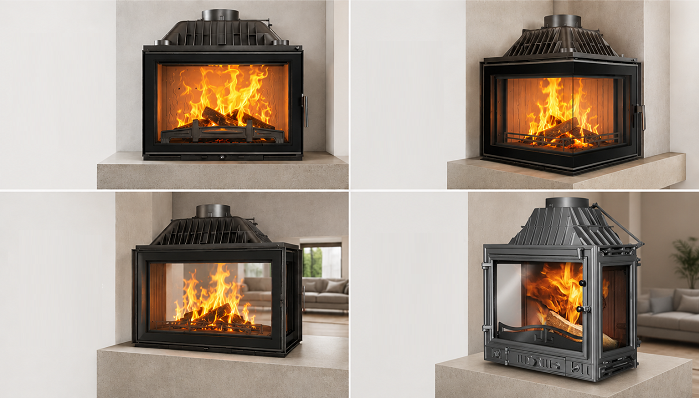
Straight cast iron inserts - classic straight closed inserts equipped with straight glass and mounted on a straight wall in the center of the room.
Corner cast iron inserts - a popular model that looks non-standard and saves space. Mounted in the corner with side glass, allowing a view of the fire from two sides.
Three-sided cast iron inserts - an improved model with fire visible from three sides—front, right, and left.
Tunnel cast iron inserts - inserts where fire is visible from front and back. Installed into interior partitions, appearing in two rooms at once.
What to look for when choosing a cast iron fireplace insert
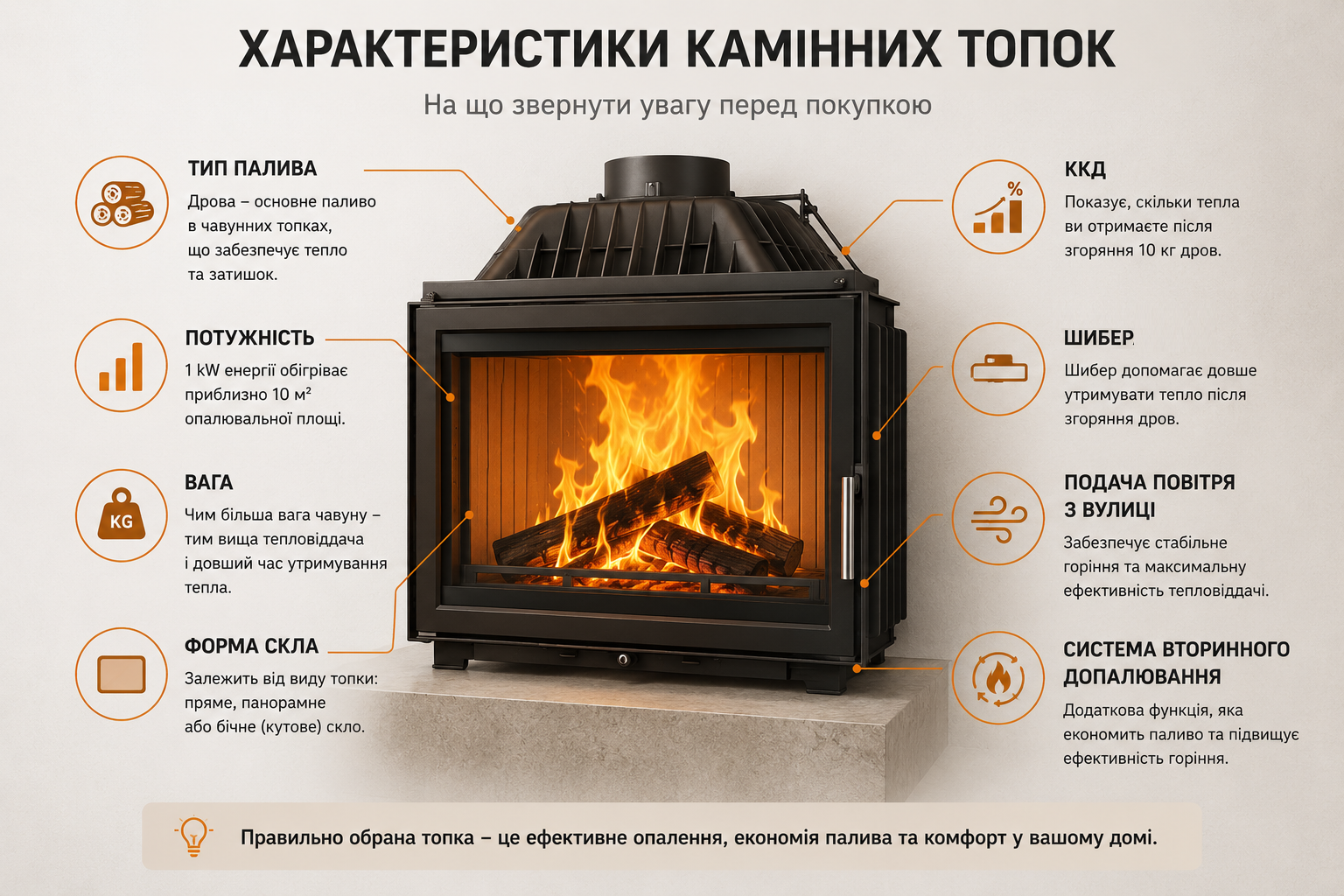
RULE 4: Studying insert characteristics. Before buying a fireplace insert, customers usually consult with a manager. Here are the main fireplace insert characteristics to understand:
Fuel type. In cast iron inserts, firewood serves as fuel.
Power. The most important characteristic, meaning the ability to heat a maximum area. Formula: 1 kW of energy = 10 sq. m of heated area.
Weight. The heavier the cast iron, the greater the heat transfer and heat retention time.
Glass shape. Can be straight, panoramic, or side (corner).
Efficiency (COP). Indicates how much heat and power you get from burning 10 kg of wood.
Damper presence. Helps retain heat longer after combustion.
External air supply. Keeps the flame supported for maximum efficiency.
Secondary combustion system. An additional function that helps save fuel.
What power to choose for a fireplace insert
RULE 5: Calculating insert power. Power should be chosen based on:
room area;
installation purpose (main heat source or decorative element).
Calculation formula: 1 kW energy = 10 sq. m heated area.
Also check: 1. diameter of the insert; 2. weight of the assembled product; 3. length of the chimney pipe.
If you're unsure, it's better to trust professionals. You can order a free home visit from a technician who will conduct calculations and advise on the best options.
Kawmet cast iron fireplace inserts
Kaw-met has its own cast iron foundry in Poland and exports to dozens of European countries. It is a market leader in fireplace inserts, stoves, and cast iron products.
Main advantages of Kawmet cast iron inserts:
latest production technologies;
high-quality cast iron;
energy efficiency and economy;
safety;
clean glass system and external air supply;
stylish design and attractive price.
Technical specifications of Kawmet cast iron inserts
Characteristics
Air heating inserts
Water jacket inserts (discontinued)
Manufacturer
Kaw-Met (Poland)
Kaw-Met (Poland)
Fuel type
Solid (firewood)
Solid (firewood)
Material
Cast iron
Cast iron
Nominal power
From 9.4 kW to 19.4 kW
From 18 kW to 25.3 kW
Warranty
60 months
60 months
Note: all Kawmet devices are long-burning fireplaces, meaning one load of wood lasts for several hours of autonomous operation.
Top-3 most popular Kawmet cast iron insert models
1. Kawmet W6: Best value for money for homes up to 100 sq.m. 2. Kawmet W17: Excellent solution for large areas up to 160 sq.m. 3. Kawmet W16: Features a wide glass (722 mm) to enjoy the view of the flame.
The KAWMET factory: 45 years and a foundry of its own
Most fireplace brands are assemblers. They design an appliance, order the castings from whoever quotes lowest that season, bolt the parts together and put a badge on the door. KAWMET is one of the few that does the opposite: it starts with molten iron. The company runs its own foundry, and the cast iron in a KAWMET stove was poured in the same works that later machined, assembled and tested it.
The story begins in 1981, when Stanisław Kawiński set up a small foundry in Wapowce near Przemyśl, in the south-eastern corner of Poland. It stayed a family workshop through the decades that reshaped Polish industry, and it is a family business still — the company is run today by his son, Marek Kawiński. In 2026 that makes forty-five years of continuous production under one name and one family. For a heating appliance carrying a five-year warranty, this matters more than it might sound: the warranty is only as good as the company standing behind it.
In 2005 production moved to a purpose-built plant at Zadąbrowie 311, near Orły, directly on the international E-4 route that runs Dresden — Kraków — Lviv. The move gave the company room for a modern moulding line and modern furnaces, and it turned KAWMET into one of the largest manufacturers of fireplace inserts in Poland. The foundry is confident enough in its capacity to take third-party casting orders alongside its own production — an unusual thing for a stove brand, and a fair measure of what the works can actually do.
How the iron is made and checked
The equipment list is worth reading slowly, because it explains why KAWMET castings are consistent from one batch to the next. Melting is done in induction furnaces with a two-tonne capacity, which give close control over temperature and chemistry. Moulds are produced on a DISA 2013A automatic moulding line and an AFI 86 moulding machine; the moulding sand is prepared in an Eirich turbine mixer. None of this is exotic by European foundry standards, but all of it is a long way from a hand-poured workshop — and it is the difference between a door that closes flush after five years and one that does not.
Quality control runs on two levels. The chemical composition of each melt is verified by spectral analysis before pouring, so the iron itself is known rather than assumed. Finished castings are then tested for strength and hardness. Cast iron is unforgiving material: get the carbon and silicon balance wrong and the casting is either too brittle to survive thermal shock or too soft to hold its shape near the fire. The testing is what keeps that from reaching your living room.
This is also the practical answer to the question people ask most often — why cast iron costs more than steel. It is not only the weight of the metal. It is a foundry, a laboratory and forty-five years of knowing what the alloy should look like.
Certificates and standards
KAWMET manufactures under two certified management systems at once: PN-EN ISO 9001:2015 for quality management and ISO 14001:2015 for environmental management. Both are covered by a single certificate, no. 1996/09/2024/ZSZ/C, issued by Polska Akademia Jakości Cert under Polish Centre for Accreditation number AC 137 and valid from 27 September 2024 to 26 September 2027. Its declared scope is the design and manufacture of fireplace inserts and cast iron castings — that is, the certificate covers exactly the work this equipment comes out of, not some unrelated part of the business.
The second standard is worth noticing. ISO 14001 governs how the plant handles emissions, waste and resources, which sits naturally alongside the Ecodesign requirements that every appliance in the current range already meets. A foundry is an energy-hungry business; a certified environmental management system is a fair sign that the manufacturer treats that seriously rather than leaving it to chance.
The heating appliances themselves were tested by the Instytut Nafty i Gazu in Kraków, an EU notified body registered under number 1450. Those test reports are the legal basis for the CE marking on the equipment, and for the declarations of performance that come with it. In other words, the efficiency and emission figures in the specification tables are not marketing claims — they are laboratory results from an independent notified body.
As the official distributor we can request the original certificates from the manufacturer for any specific model. If you need documentation for a building permit, a chimney inspection or a subsidy application, ask us and we will obtain it.
Where to buy KAWMET
You can order any model directly on this site — add it to the basket and fill in the form, and a manager will confirm availability, the final price and the delivery date. If you would rather talk first, that is usually the better route: the choice between an insert and a stove, and the choice of output, depends on your room, your chimney and whether the fire is your main heat source or a pleasant addition. That conversation takes ten minutes and saves a great deal of regret.
Every appliance comes with the five-year factory warranty on the body and with our service after it expires. Because we are the official distributor, we hold factory spare parts — glass, seals, grates, baffles and firebricks — rather than ordering them from a third party and hoping.
KAWMET is not the only brand we represent officially. If you are still deciding, it is worth looking at the Danish MORSO range as well: same material, different tradition, different design language. We sell both, so the advice you get from us is not a sales pitch for whichever one we happen to stock.
Don't know how to choose a fireplace or stove? Leave a request for a free consultation with our specialist
We will answer all the questions that concern you:
how to choose a stove or fireplace for your type of room
which is better to choose if you want to heat the whole house
what components are necessary for the installation of a firebox or stove
and all other questions that concern you
Find your nearest representativeSAVEN authorized representatives are located in many countries. You can buy your dream fireplaces and stoves from them, as well as receive appropriate support. Thanks to the high qualification of our dealers, you can count on the highest quality of service and dispel your doubts.See the addresses of representatives


 Straight steel fireplace inserts
  Corner steel fireplace inserts
  Fireplace inserts with guillotine
  Steel fireplace Balance
  Steel fireplace stoves
  Fireplace cassette insert
  Cast iron fireplaces and stoves KAWMET
  Cast iron stoves MORSO
  Fireplace ventilation grilles CLASSIC
  Fireplace ventilation grilles HIDE
  Fireplace ventilation grilles LOFT
  Fireplace ventilation grilles LOFT ANGLE
  Accessories
  Chimneys
  Decorative frames
  Fireplace Automation